Bike Polo Rules: Technical Penalties
📘 This guide covers Section 7 of the North American Hardcourt Bike Polo (NAH) Ruleset, the standard used at tournaments across North America.
Bike Polo Rules: Technical Penalties
Not every penalty comes from a hard hit. Section 7 covers fouls about timing, positioning, and behavior: stalling the game, arguing with the Ref, blocking players who don't have the ball, messing up a line change, and hanging out in the crease.
These fouls use the penalty levels from Section 6 (Ball Turnover, Minor, Major, and Personal Misconduct). This post covers what each foul looks like.
⏳ Delay of Game
Delay of Game is called when a player:
Stalls a restart, for example by not getting back to their own half (see Section 4)
Pins the ball with their bike while leaning on the boards
Shields the ball while dabbed, using their bike, body, or mallet
Scoops or throws the ball out of play on purpose
Moves the goal on purpose to stop play
🗣️ Unsporting Conduct
(called "Unsportsmanlike Conduct" in the NAH Ruleset)
The Ref calls this when a player acts unsportingly. Examples include:
Disrupting the game or protesting the Ref's calls too much
Moving an opponent's dropped mallet to make it harder for them to pick up
Not tapping in or leaving the play after dabbing
These can be a Minor, Major, or Personal Misconduct, depending on the Ref.
Assault is automatic. Verbal or physical assault of anyone — a Ref, goal judge, timekeeper, organizer, spectator, or player — is always a Personal Misconduct.
🚧 Interference
Every player without the ball has the right to go after the ball or the ball carrier, and to move freely to get into position. Interference is when someone takes that away. There are three kinds.
Bike Interference (Screening or Picking)
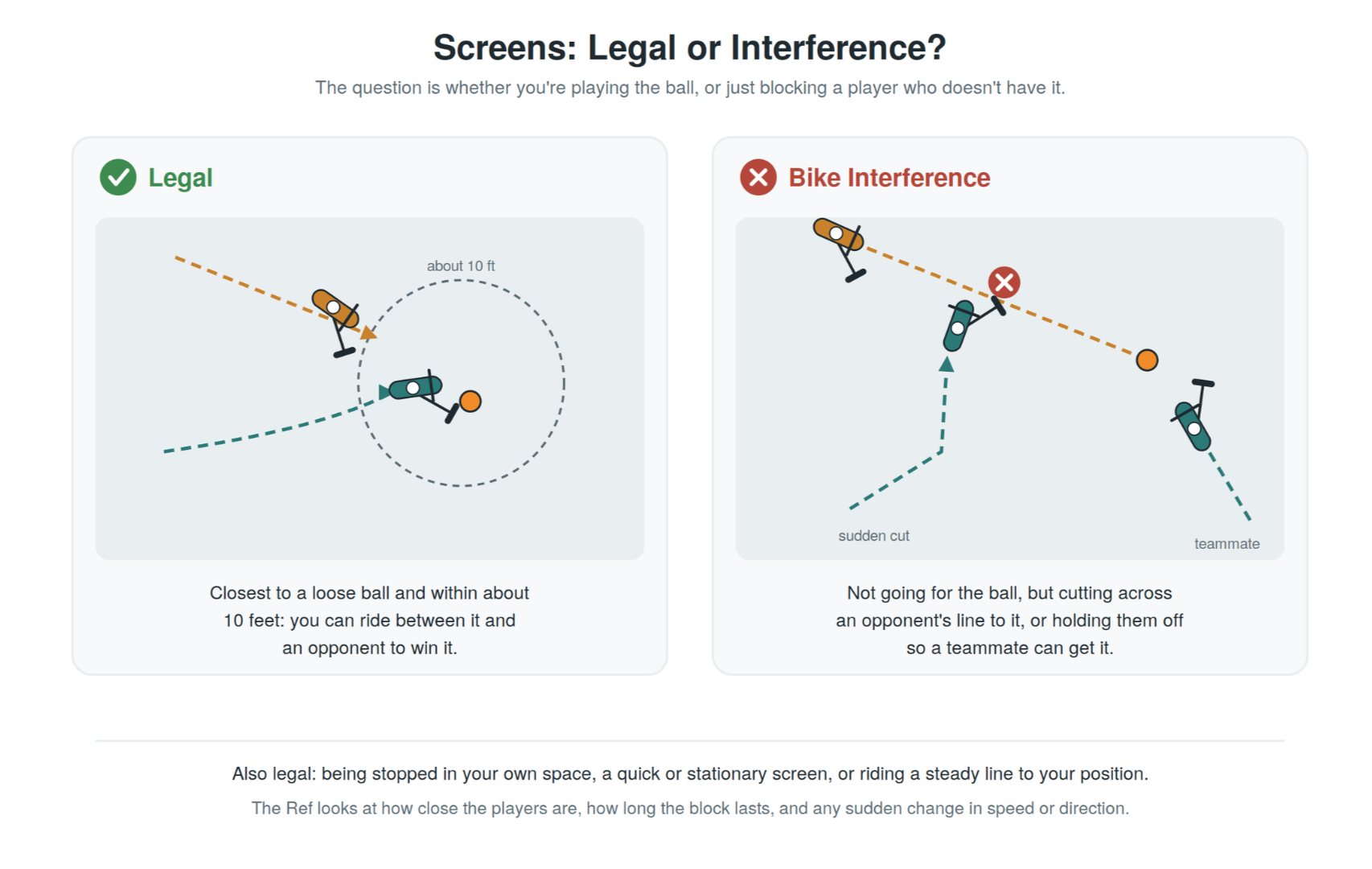
It's a penalty to use your bike to block an opponent without the ball by cutting them off suddenly or holding them off, so they can't get to a loose ball, challenge the ball carrier, or get into position.
It's not a penalty when:
You're stopped and just taking up your own space
You're moving at a steady, predictable speed toward your own position
You're the closest player to a loose ball and screen within about 10 feet of it to get the ball safely
The screen is stationary or only lasts a moment
Two players heading straight for a loose ball get in each other's way naturally
Players going for a loose ball have to move directly toward it, or let it go.
Once a player loses the ball (it gets more than 12–15 feet away, as covered in Section 5), they can't be screened anymore. If you hold a screen to stop them from going after the loose ball, that's interference.
Body Interference
It's a penalty to start physical contact with an opponent who doesn't have the ball. Once the ball gets away from a player, they can no longer be contacted.
Mallet Interference
It's a penalty to use your mallet to hold back or block an opponent's mallet, body, or bike.
You can tie up an opponent's mallet, but only when they have the ball, and you're both close enough to play it. Things that cross the line include:
Slashing, tapping, or lifting an opponent's mallet repeatedly without going for the ball
Pinning their mallet for a long time without going for the ball
Reaching around the ball carrier from the front or back to block their mallet
Tying up the ball carrier's mallet so your teammate can take the ball
How the Ref Judges Interference
How close the players are
How long the block lasts
Whether there was a sudden change of speed or direction
Whether contact was used to set up the block
🔁 Illegal Substitution (Squad and Bench)
Teams with a bench can sub during live play, stoppages, and timeouts. Either team can also sub before and during a player advantage, except for the player serving the penalty.
The player coming off needs at least one wheel in the transition area around their door before the new player can cross onto the court.
If either player plays the ball or the ball carrier while both are in the transition area, it's a Minor, served by the player who did it. If a loose ball just bounces off one of them, there's no penalty.
If more than three players from one team are on the court and involved in play, it's a Major. The player who came on last serves it, and the team picks one more player to sit out, so they play with two for the length of the penalty.
🥅 Crease Violation
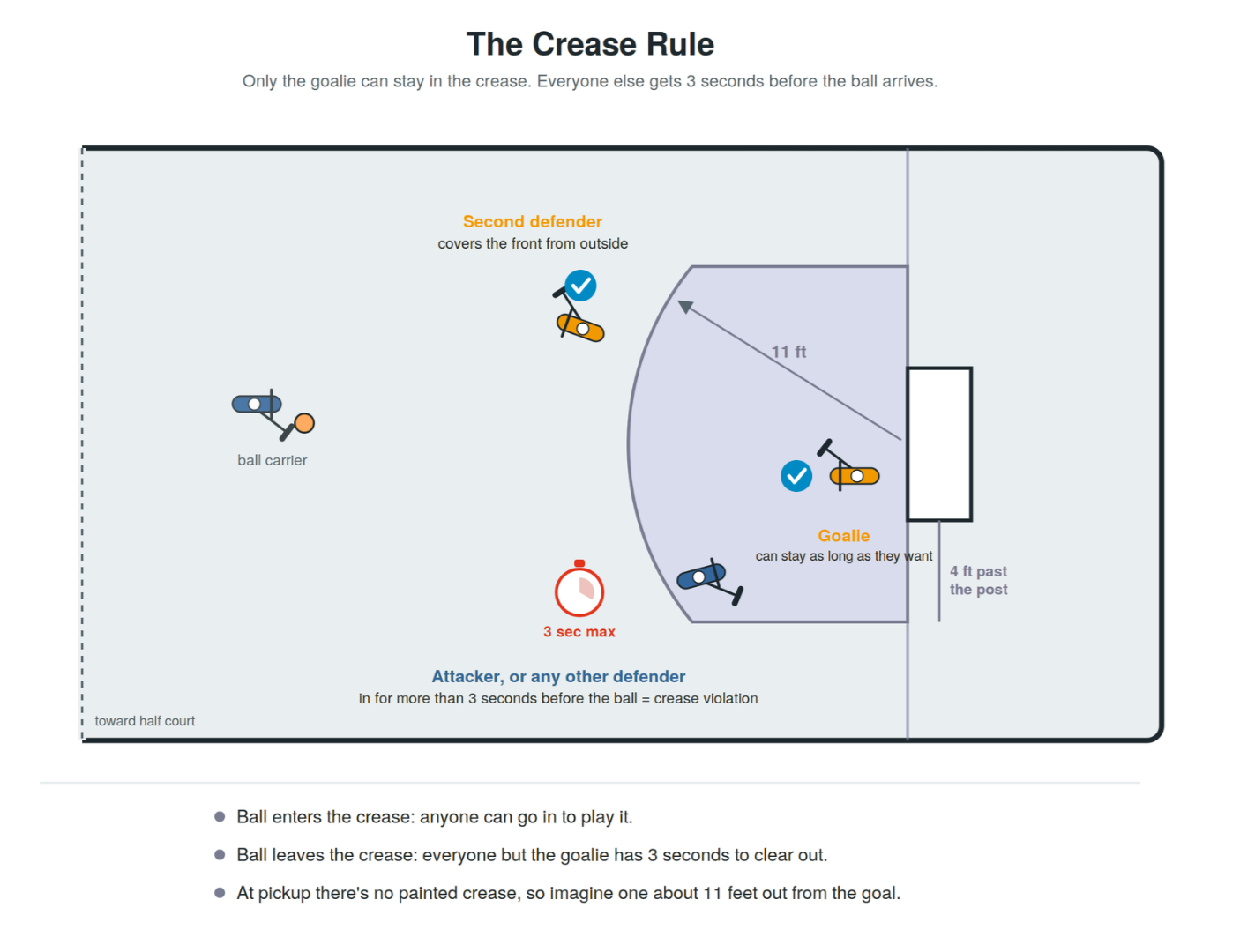
Only one defender, the goalie, can stay in the crease for more than 3 seconds before the ball or ball carrier gets there. Any other defender, or any attacker, who stays in longer is called for a crease violation.
When the ball enters the crease, anyone can go in to make a fair play on it.
When the ball leaves, everyone except the goalie has 3 seconds to get out. A player who stays and gets in the way of the next attack is penalized.
Contact in the crease is only allowed as a direct play on the ball or ball carrier.
If an opponent traps you in the crease so you can't leave in time, you're not penalized.
How severe it is:
No scoring chance at stake: a Ball Turnover. Repeat violations go to a Minor and then a Major.
Clear scoring chance from a shot, pass, or loose ball in or near the crease: a Minor right away. Repeat violations are Majors.
Crease violations escalate by team, not by player. If one teammate gets called and a different teammate does it next, the penalty still goes up a level.
Quick Reference
Penalties and What They Look Like
Delay of Game - Stalling a restart, pinning or shielding the ball, throwing it out, moving the goal
Unsporting Conduct - Arguing calls, moving a dropped mallet, not tapping in; assault is automatic Personal Misconduct
Bike Interference - Using your bike to block a player without the ball
Body Interference - Contacting a player without the ball
Mallet Interference - Tying up a mallet when the player doesn't have the ball, or without going for it yourself
Illegal Substitution - Coming on before your teammate is in the transition area, or too many players on court
Crease Violation - A second defender, or any attacker, in the crease for more than 3 seconds when the ball is not present
Bringing It Back to Pickup
We don't draw a crease before pickup, so we imagine one, roughly 11 feet out from the middle of the goal, which is a little less than two bike lengths. Calls are loose because nobody can see the line, but the habit is still worth building. If you're covering the front of the goal and you're not the goalie, keep yourself outside that space, or ride in and back out within 3 seconds.
At a tournament, the crease is painted or taped on the court, and you will have already formed that habit.
📚 Read the Full Section
This post is based on the NAH Ruleset (2022 edition). The full rulebook is here:
👉 https://www.nahardcourt.com/rules/
Check for updates before you ref or organize a game.
Next up: Section 8, covering bike handling penalties.