Bike Polo Rules: Penalty Format
📘 This guide covers Section 6 of the North American Hardcourt Bike Polo (NAH) Ruleset, the standard used at tournaments across North America.
Penalties
At pickup, we sort out most fouls ourselves: give the ball back, apologize, keep playing. At tournaments, the Ref decides how serious a foul was and what it costs. Section 6 is the system behind those calls.
This post covers how penalties work in general. Sections 7–10 cover specific fouls (crease violations, dabbing, slashing, and charging) and use the penalty levels explained here.
⚖️ How the Ref Decides Severity
The goal of a penalty is to cancel out whatever advantage the foul created. The Ref looks at four things:
Where it happened. A foul is more serious the closer an attacker is to the other team's goal, or the closer a defender is to their own.
Whether it stopped a breakaway. Fouling a player who's facing an open net ofalone with the goalie is more serious than fouling a player who still has two defenders to get past.
How hard and how dangerous it was. Speed, force, and the risk of injury are all considered.
How much it changed the play. The bigger the effect on what was developing, the bigger the penalty.
🚦 The Penalty Levels
Ball Turnover
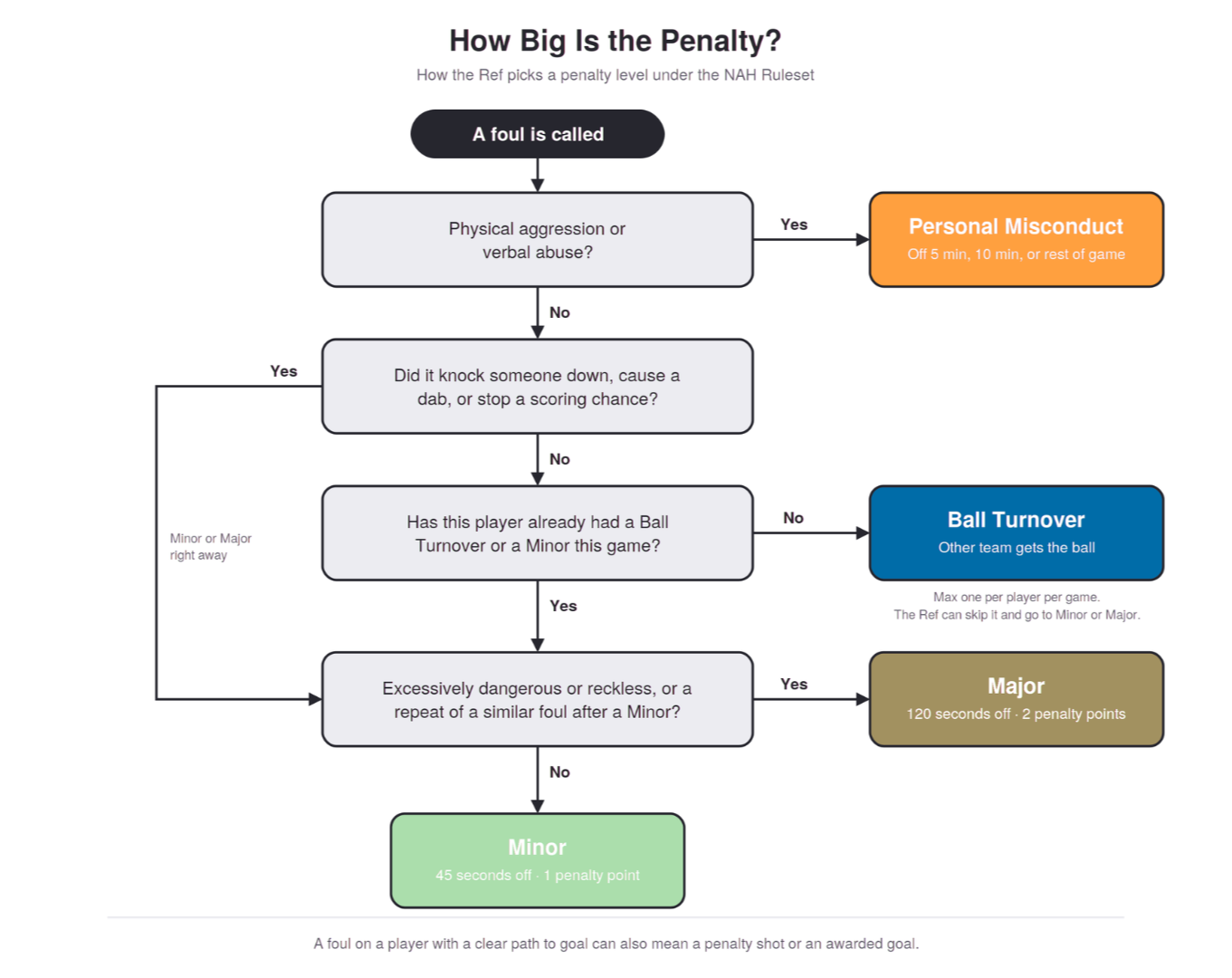
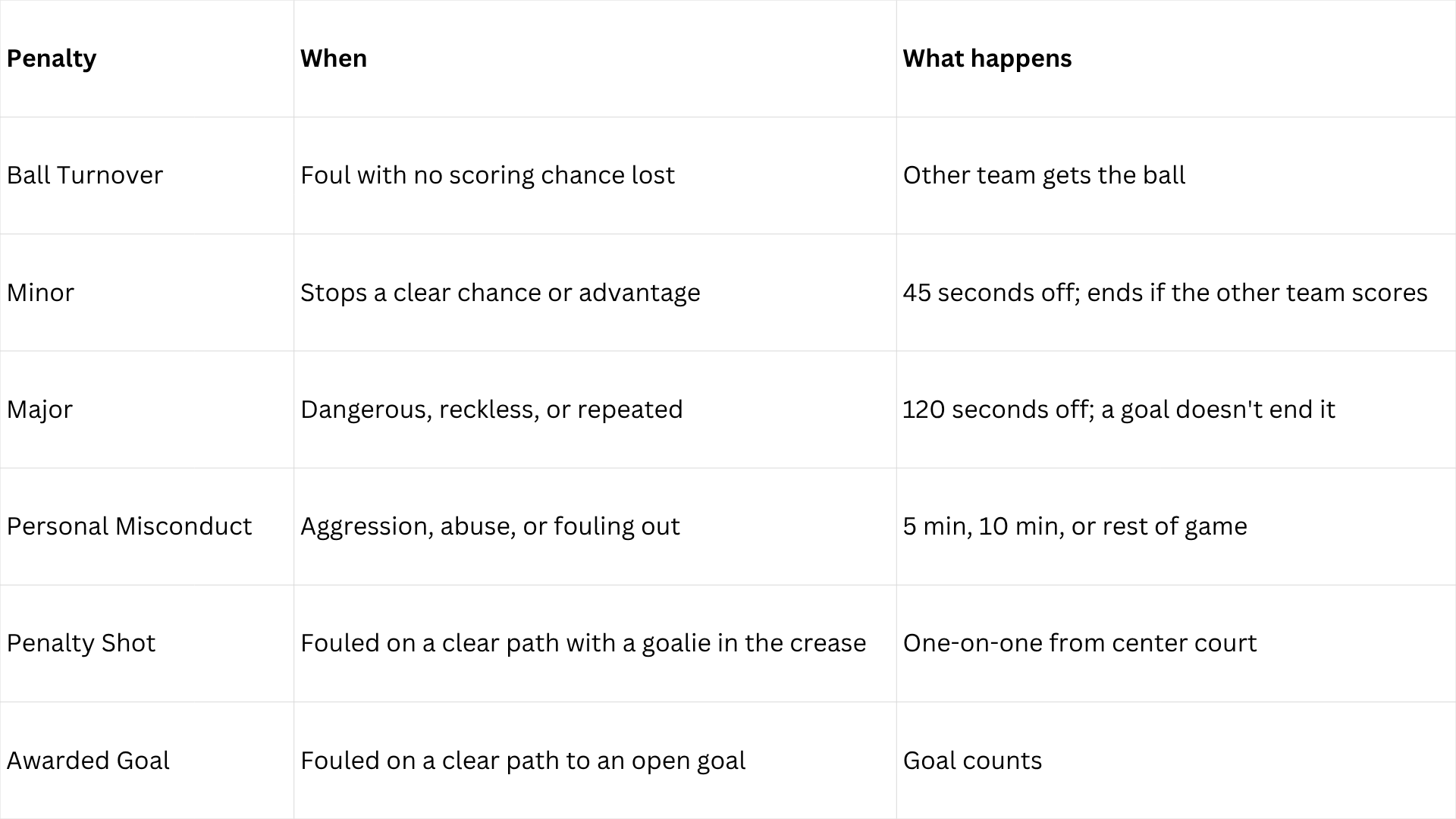
A foul in a neutral spot that didn't take away a clear scoring chance. The fouled team gets the ball, and play restarts.
Minor (45 seconds)
A foul that takes away a clear scoring chance or a significant advantage, plus certain specific fouls named in Sections 7–10. The fouling player leaves the court for 45 seconds, and the fouled team gets the ball. If the fouled team scores, the penalty ends early, and the fouling player can return.
Major (120 seconds)
A foul the Ref considers excessively dangerous or reckless, or a repeat of a foul after a Minor. The player leaves for 2 minutes. A goal does not end a Major penalty.
Personal Misconduct
Physical aggression, verbal abuse, or fouling out (see below). The Ref can stop play right away to end an altercation. The player is off for 5 minutes, 10 minutes, or the rest of the game, at the Ref's discretion. Their team plays with two players for 45 seconds on a first offense, or 2 minutes on later offenses, before a third player can come on.
If a team gets multiple severe misconduct penalties in one game, the Ref ends the game, and that team forfeits. Tournament organizers and the head Referee can also remove the team from the tournament, and the head Referee decides the final score.
⏱️ Serving a Penalty: Player Advantage
When a player gets a Minor, Major, or Personal Misconduct, they leave the court, and their team plays with two. This is called a player advantage.
The player waits by their door. The Ref or Official counts down from 5 and points to the door when they can come back in.
They don't have to tap in at half court. They're back in play as soon as they cross onto the court.
Every stoppage pauses the penalty timer, even in squad games where the game clock keeps running.
If the penalized team commits another foul during the advantage, the advantage is extended by 45 or 120 seconds, depending on the new penalty. The player with the more serious penalty stays off.
In squad games, the team can still rotate its two on-court players as usual, unless the penalty is a Personal Misconduct.
📈 Escalation: Your First Foul vs. Your Next One
The ruleset gives players a little room for a first minor foul, and none after that.
A foul that doesn't knock anyone down, cause a dab, or stop a scoring chance gets at most one Ball Turnover. After that, every foul is a Minor or Major. The Ref can also skip the turnover and go straight to a Minor or Major.
A foul that knocks someone down, causes a dab, or stops a scoring chance is a Minor or Major right away.
Per player: once you've had one Ball Turnover or one Minor in a game, every foul you commit after that is a Minor or Major.
🚪 Fouling Out
Players earn penalty points during a game:
Minor = 1 point
Major = 2 points
Personal Misconduct = all your points at once
The limit is 3 points in games of 25 minutes or less, and 4 points in longer games. Reach the limit, and you've fouled out. You leave the court and can't come back that game. Your team plays with two until the penalty time runs out. In squad games, another player can come on after that. In 3v3, the team finishes the game with two.
Across a tournament: a player who fouls out twice sits out their team's next game, and each foul-out after that means sitting out another game. Teams with four or more players are always guaranteed at least three eligible players in a game. Tournament organizers keep track, and the Ref tells a team before a game if one of its players is ineligible or close to the limit.
🙋 Delayed Penalties
When the Ref calls a penalty depends on which team fouled.
If the team with the ball fouls, the Ref blows the whistle right away.
If the team without the ball fouls, the Ref raises an arm, calls "Advantage" with the team's name, and lets play continue so the fouled team doesn't lose its attack.
A delayed penalty is called when:
The team that fouled gets possession
The ball goes out of play
The fouled team takes the ball back into its own half and behind its own goal line
While a delayed penalty is pending:
The fouling team can't score. The only exception is if the team with the ball knocks it into its own goal, also known as an “own goal”.
If the fouling team fouls again, the penalty goes up one level: a Ball Turnover becomes a Minor, and a Minor becomes a Major. It can't go higher than Major. If several players fouled, only one serves the penalty, chosen by the Ref.
If the fouled team scores, there's no ball turnover. The team that was scored on keeps the ball, and the game restarts as outlined in Section 4, but they still must serve any Minor, Major, or Misconduct penalty after the goal.
If the fouled team commits a foul, the Ref stops play and handles it normally.
🤝 Coincidental Penalties
When players on both teams get penalties at the same time:
If both are Ball Turnovers, play stops and restarts with a joust.
If they're Minor or higher, the game goes 2-on-2 for the length of the penalties, even if someone scores.
🎯 Penalty Shots and Awarded Goals
Penalty shot
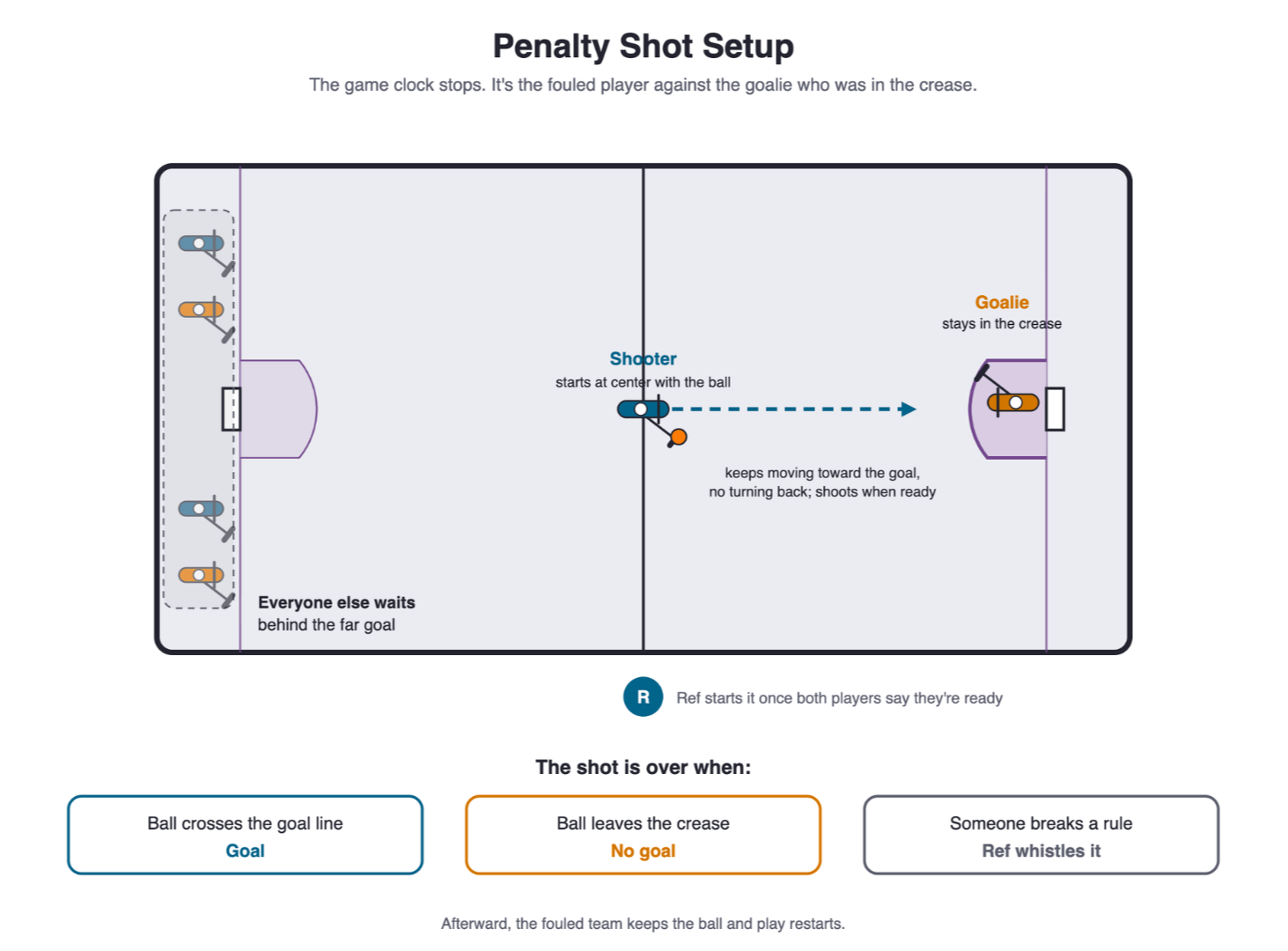
If a player with the ball has a clear path to a goal defended by a goalie in the crease, and gets fouled, they get a penalty shot. The game clock stops.
The fouled player takes the shot. The defender who was in the crease defends it.
Everyone else goes behind the goal at the other end of the court.
The shooter starts with the ball at center court and goes when the Ref confirms both players are ready.
The shooter has to keep moving toward the goal and can't turn back. They can shoot whenever they choose.
The goalie has to stay in the crease the whole time.
It's over when the ball goes in (goal), the ball leaves the crease (no goal), or someone breaks a rule. Afterward, the fouled team keeps the ball.
If the foul was also a Minor,
Make a goal and the penalty ends, so the team plays with three.
Miss the goal and the player advantage goes ahead.
If the foul was a Major, the penalized team plays with two either way.
Awarded goal
The Ref stops play and gives the team a goal if:
A player with the ball is fouled while they have a clear path to an open, undefended goal
The ball hits a dabbed defender in front of their own goal
📋 Appeals
Teams can appeal a penalty or a penalty-point total to the tournament organizers, but only after the game, never during it. Organizers talk with the refs, goal judges, and both captains before deciding, and they encourage video if anyone has it.
Quick Reference
Seeing It in Action
You don't need to know any of this to play pickup. If you want to see how penalties work in real time, reffing or goal judging at a tournament is the best way to learn it. Section 1 covers what each job involves.
📚 Read the Full Section
This post is based on the NAH Ruleset (2022 edition). The full rulebook is here:
👉 https://www.nahardcourt.com/rules/
Check for updates before you ref or organize a game.
Next up: Section 7, covering technical penalties.