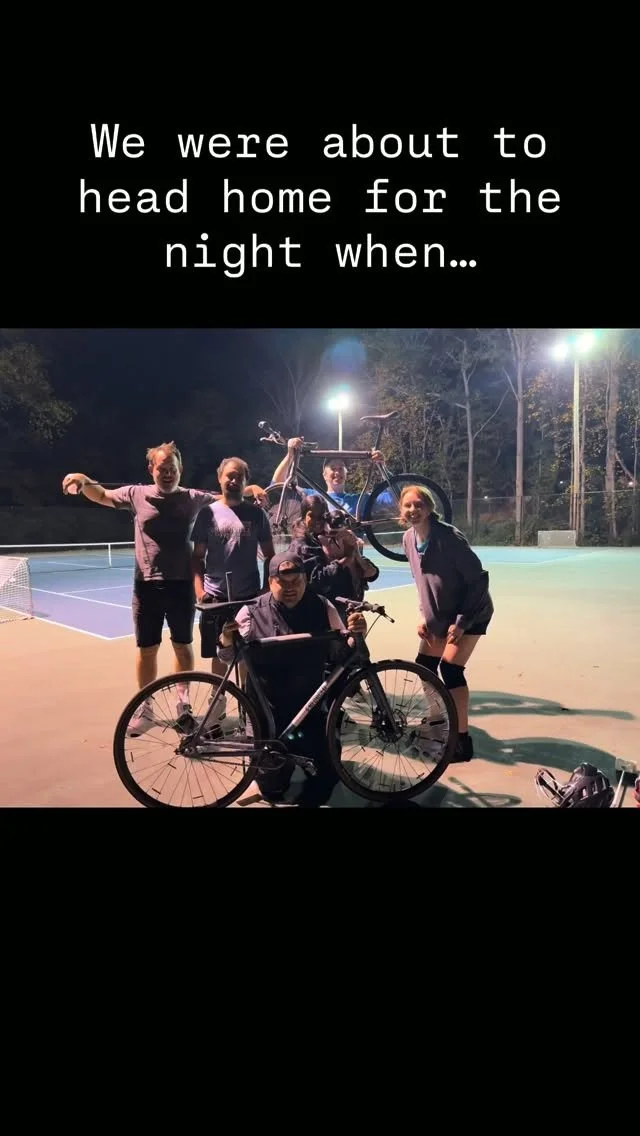
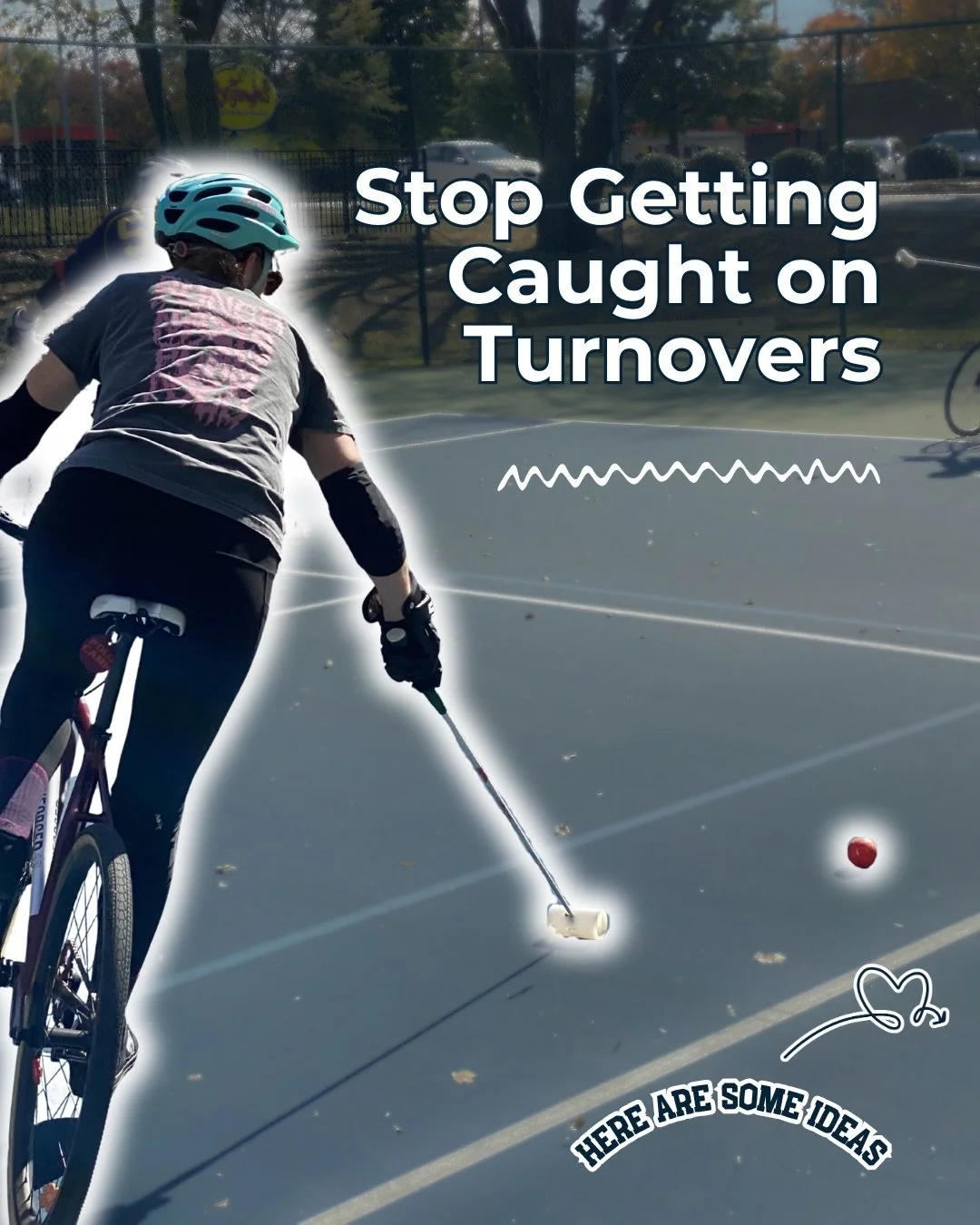
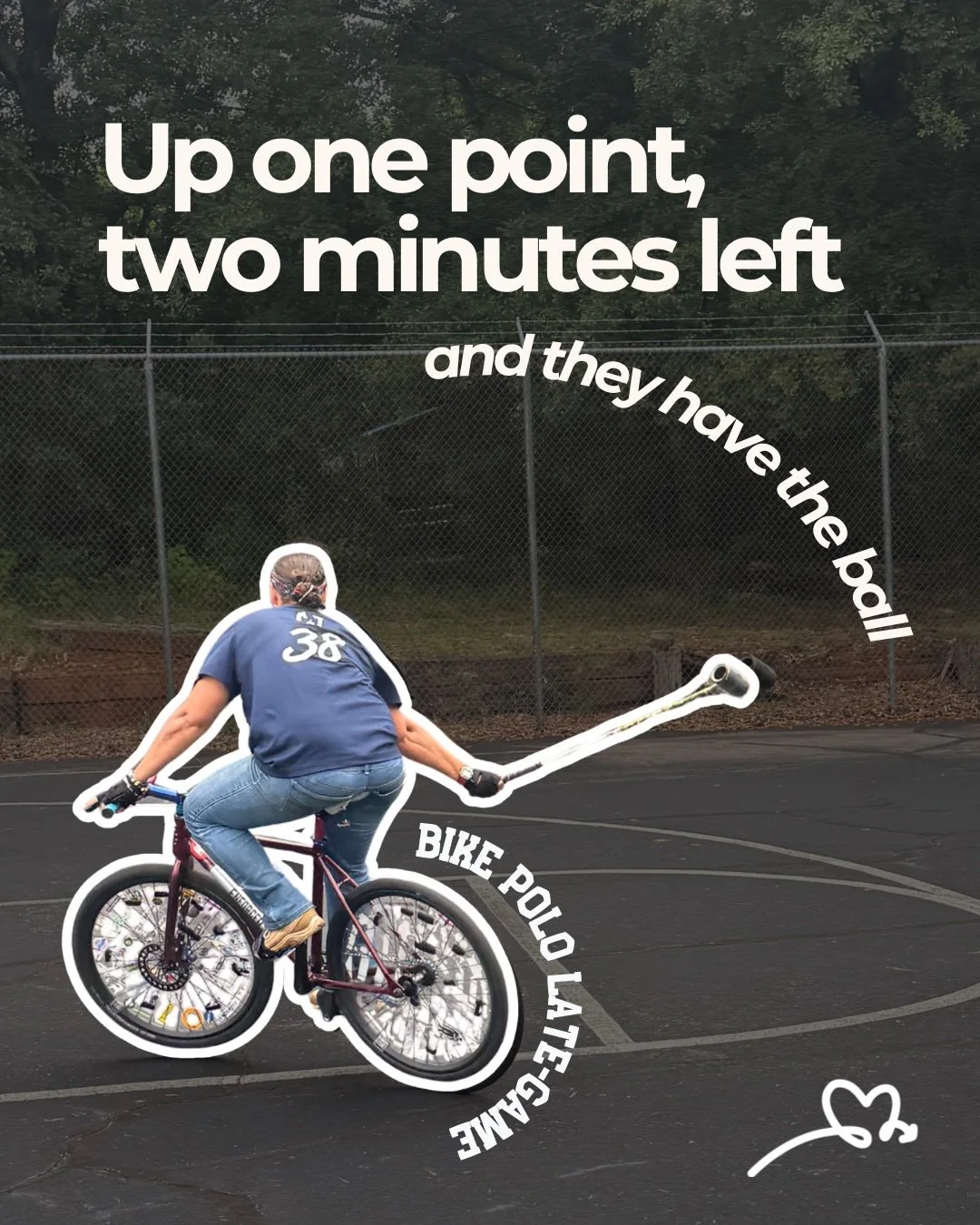
If you organize pickup for a polo club, this post walks through the sign-in sheet and setup checklist we use at GVL, including the points system, costs, and a printable template. If you play with us, it explains what that clipboard is and why we keep asking you to initial things.
The short version: one sheet tracks who showed up, who's new, and who helped set up and tear down the court. Helping earns points. Nobody has to do anything, but the work gets spread around, and the people doing it get noticed.
How pickup runs at GVL
We play open pickup three times a week:
Tuesday evening at Gateway Park in Travelers Rest
Saturday afternoon at Gateway Park in Travelers Rest
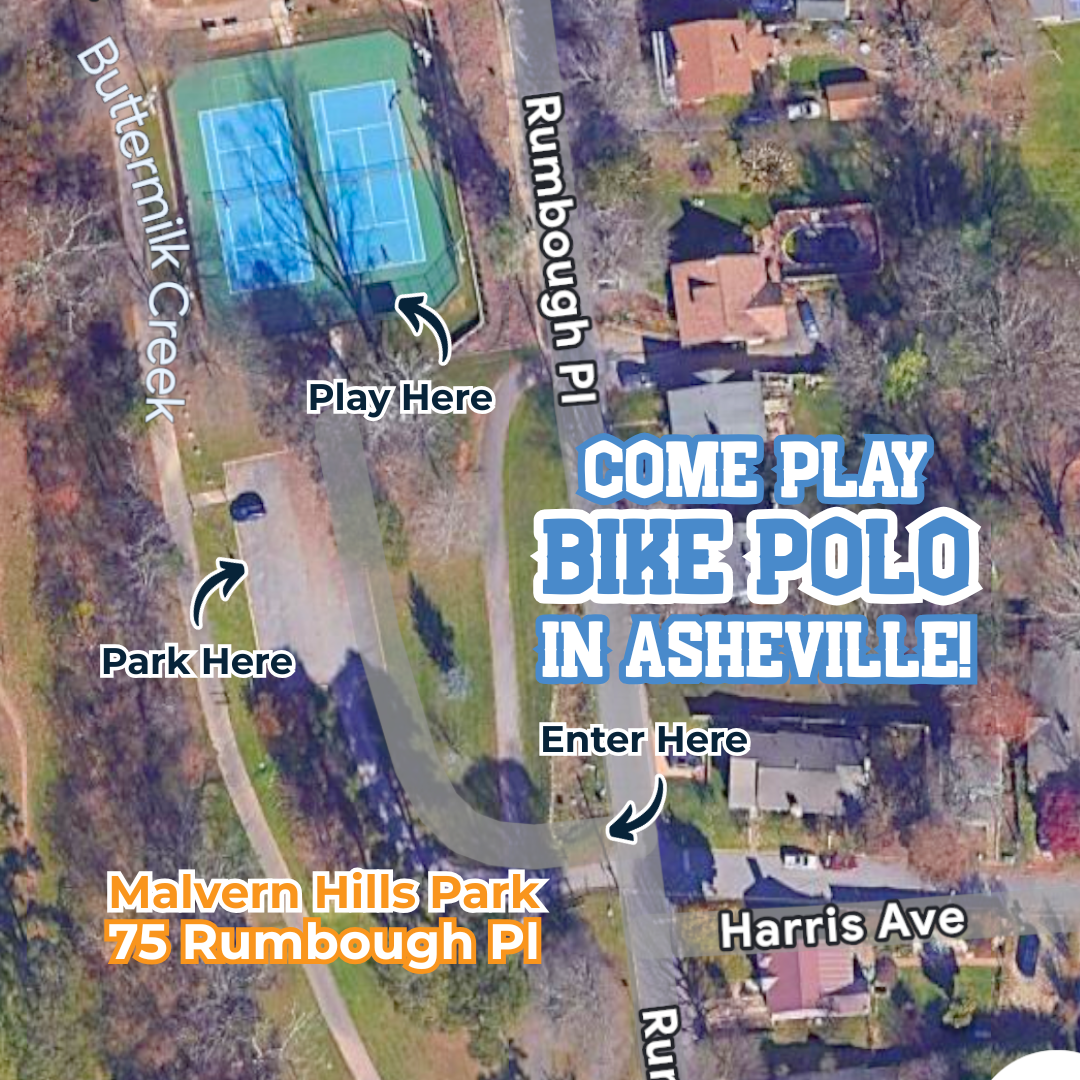
Sunday afternoon at Malvern Hills Park in Asheville, with AVL Bike Polo
Making games. We use a set of handmade wooden signs to sort mallets into games. You can read the full explanation on our blog, but here’s a short version.
Three come out every session:
Big Toss. When you come off the court, your mallet goes here.
On Deck. We randomly draw six mallets from Big Toss. These players are up next.
In the Hole. We place any remaining mallets here. This will be the game after.
Three more signs come out by request: Learning Game for slower games where newer players get room to try things, WTFNB Priority to give women, trans, femme, and nonbinary players first pick into games, and Tournament Practice for teams prepping for an event.
The signs handle who plays next. We also have a sign-in sheet that handles everything around the games: who's here, who's new, and who contributed to the session. It lives on a clipboard next to the signs so people see it as soon as they roll up.
The sign-in sheet
One landscape page, printed fresh for each session.
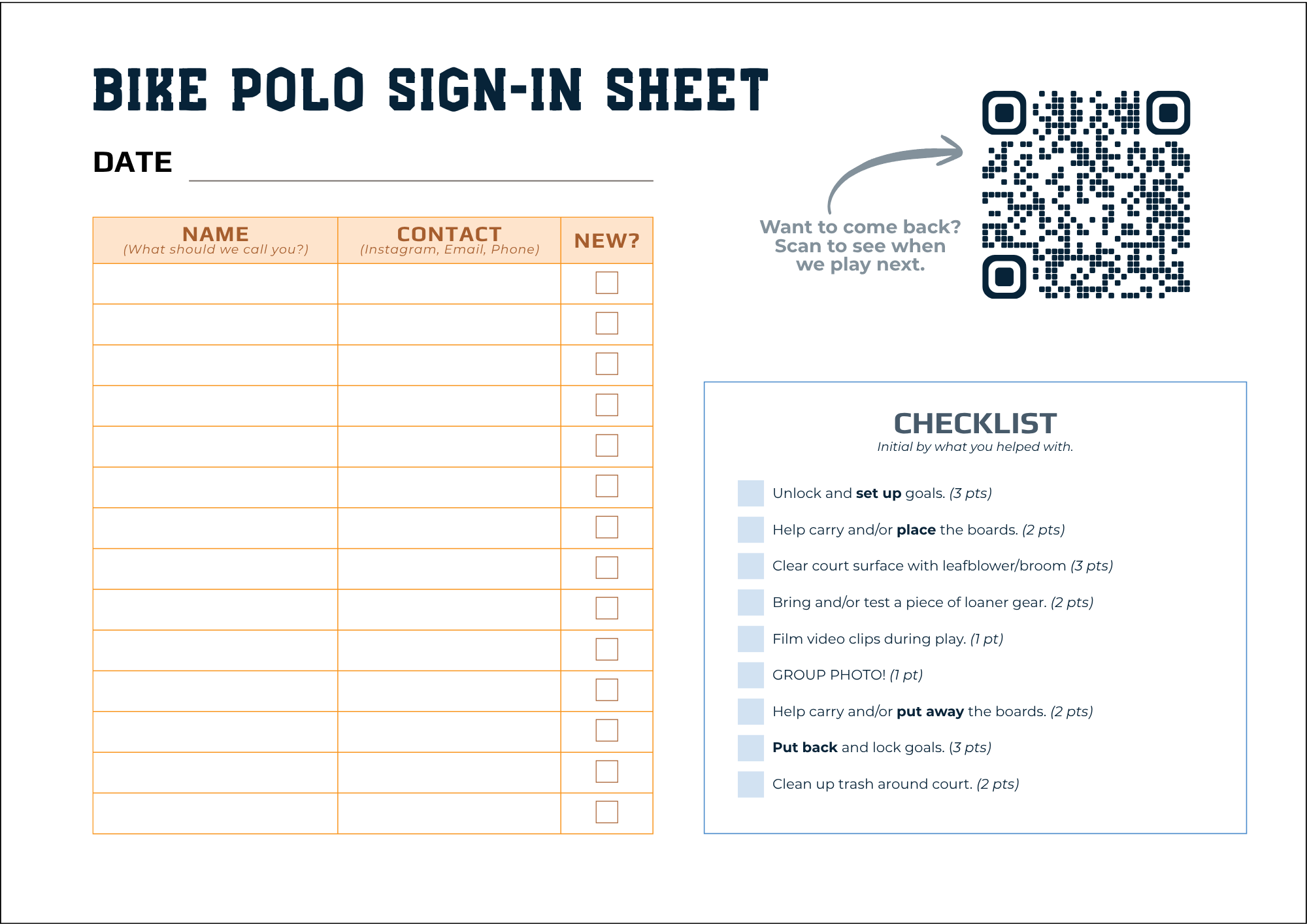
Left side: sign-in. Three columns.
Name ("What should we call you?"). This invites nicknames and chosen names without making anyone explain.
Contact (Instagram, email, or phone). Optional. If you want us to remind you about pickup, we’ll use this to contact you. Leave it blank if you'd rather not.
New? A checkbox. When someone ticks it, whoever's nearby knows to say hi, offer a loaner bike or mallet, and teach the rules.
Top right: QR code. It goes to our links page, with an arrow and the line "Want to come back? Scan to see when we play next." This gives people a way to stay in touch without writing anything down.
Bottom right: checklist. Initial next to what you helped with. Multiple people can initial each item. Each task has a point value:
Unlock Goals (3 pts) - Unlocked the goals and got them positioned for the start of play.
Set Up Boards (2 pts) - Helped carry and/or place the court boards before play started.
Clear Court Surface (3 pts) - Used a leaf blower or broom to clean leaves, acorns, and other things from the play area.
Test Loaner Gear (2 pts) - Brought and/or tried a piece of loaner gear to make sure it's still in working shape.
Take a Video (1 pt) - Filmed at least one clip during play (doesn't need to be edited, just captured).
Take a Group Picture (1 pt) - Got a photo with the whole group of players, at any point in the session.
Took Down Boards (2 pts) - Helped carry or put away the court boards after play finished.
Lock Goals (3 pts) - Put the goals back and locked them at the end of play.
Clean Trash (2 pts) - Picked up trash from the court area and park, leaving the area better than we found it.
Higher points go to the jobs that are heavy, need specific knowledge, or tend to get skipped. Lighter, fun tasks still count, so everyone has an easy way to contribute.
What points are for: One point is worth about $1 in prizes. A regular who helps most sessions earns around 15 points a month. We’re still deciding what prizes to give out, but ideas include new polo balls, trinkets, games, mallet heads and shafts, and bike parts.
Bingo and blackout. Our monthly bingo cards plug into the same system. When you get a bingo, you choose: take a small prize now or bank 5 points. A blackout is a medium prize now or 15 points banked. People who want an instant reward can take one, and people saving for gear can build toward it.
The community gear pool. You can donate any of your points to the pool. We can use pooled points to build a mallet for a newer player, or work on a loaner bike.
Launch checklist
To build our checklist, we focused on what our court and players need each week.
Before the first session
List every setup and teardown job our court actually needs before polo can be played.
Assign point values. Weight heavy, skilled, or often-skipped jobs higher.
Decide what points earn, and how often we'll tally them (weekly, monthly, per season).
Make a QR code that goes to our links page.
Design and print the sheet. Print a stack so we're never caught without one.
Put a clipboard, pens, and the sheets in our court kit.
First few sessions
Hand the clipboard to people as they arrive instead of waiting for them to find it.
Point out the checklist before setup starts, and again at the end.
Check that new players got a hello and the gear they might need.
Every session
Clipboard out with the pickup signs.
Before people leave, remind them to initial what they did.
Take the sheet home (photo it if it's damp).
Monthly
Tally and record points.
Note who was new and whether they came back.
Look for jobs nobody's initialing and adjust the points or ask directly.
Thank the people who've been helping, by name, where it fits.
Roles
The goal is for no single job to depend on one person. Here's what a typical session needs:
Sheet keeper - Brings the clipboard, greets new players, takes the sheet home
Goal setup and teardown - Needs someone who has the lock combination or key
Boards setup and teardown - Many hands make light work
Loaner gear check - Tires, brakes, mallet heads
Filming or photos - Optional, nice to have
Trash sweeper - Five minutes with a bag
At a small session, two or three people can cover all of this. The sheet's job is to make it obvious when the same people keep doing it, so you can ask someone new to learn the goal lock or carry boards.
Materials and rough costs
Costs are approximate US prices. Most clubs already have some of this lying around.
Clipboard - $5 to $10 - A storage clipboard with a lid keeps sheets dry
Pens - $5 - Bring more than you think. Tie one to the clipboard.
Printing - About $0.10 to $0.25 a sheet - Black and white works fine
Waterproof sleeve or zip bag - $3 to $5 - For damp days
QR code - Free - Most free generators work. Test it before you print.
Prizes - Varies - Whatever your points earn. Some of ours are donated or handmade.
Starting from nothing, plan on $20 to $30 plus prizes. After that, the only ongoing cost is printing, but we’ve also talked about using a laminated page with a dry-erase marker.
Ways to set up your own
There's no single right version. Pick what fits your club's size and how much tracking you want to do. You might want to use our weighted score system, or just assign a point per task, or use no points at all. You might want to track on paper like us, use a reusable laminated page, or keep it all in a spreadsheet. You might want to offer prizes, shout out helpers, or run a raffle. It all depends on how your club responds and what you need.
Templates
Sign-in sheet with checklist (PDF). You can print this version and write in your own checklist items, or use it as a starting point.
Editable version (Canva). You can also edit our Canva template here with your own colors, tasks, and QR code.
If you adapt this for your club, we'd love to see it. Send us a message or tag us on Instagram.
Come play with us
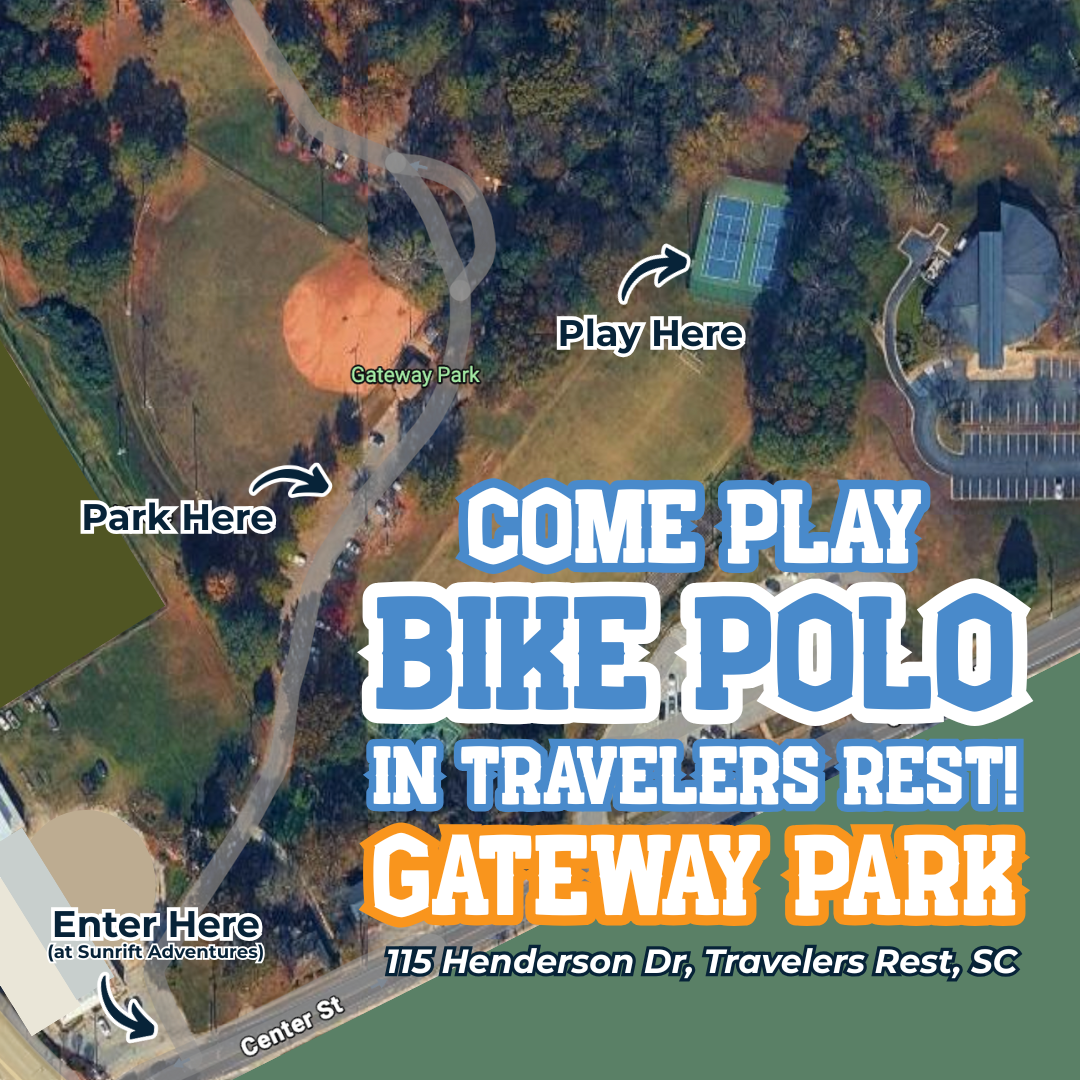
We play Tuesday evenings and Saturday afternoons at Gateway Park in Travelers Rest, and Sunday afternoons at Malvern Hills Park with AVL Bike Polo
Loaner gear is available, and no one expects you to know any of this on your first day. Follow @GVLBikePolo on Instagram for updates.